The Most Common Relining Job in This County Has Nothing to Do With Damage
It is a sizing problem, and it starts with a decision somebody made years earlier for sensible reasons.
A great many houses around Show Low and Pinetop were built between the mid-seventies and the late nineties with a large open masonry fireplace and a clay flue sized to match it - commonly 12 by 12 inches, sometimes larger. That is correct for an open fire, which needs a lot of flue to carry a lot of cool, dilute smoke.
Then, somewhere along the line, the owner got tired of watching the heat go up the chimney and fitted an insert or a freestanding stove in front of the opening. A wood insert vents through a 6-inch collar. A pellet appliance vents through 3 or 4 inches. Both of those are now trying to push a small volume of hot exhaust up a flue with four to six times the cross-section they were designed for.
What happens next is predictable. The exhaust expands, slows and cools long before it reaches the top. Cool exhaust condenses. Condensate on a cold clay wall is exactly the recipe for the hard glazed creosote we describe on the sweeping page - which is why some of the worst flues we open belong to people who burn very little. Meanwhile the appliance never drafts the way the manual promises, so the owner concludes the stove is a bad stove.
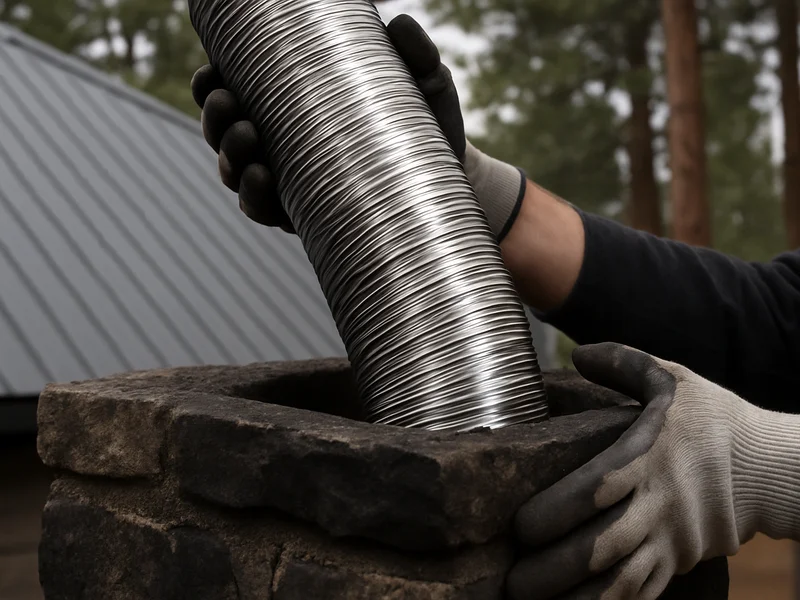
A correctly sized insulated liner from the appliance collar to the top of the stack fixes the draft, the creosote rate and the cold-start smell in one go. It is also what the appliance manufacturer's listing required in the first place - almost every insert and stove sold in the last thirty years specifies a continuous liner to the termination, and an installation without one is outside its listing.
What's Included
- Flue measured at the top and at the appliance - not estimated from the outside of the stack
- Camera run down the existing flue where access allows, footage handed over either way
- 316Ti or 304 stainless liner sized to the appliance, insulated where clearance requires it
- Top plate, storm collar and rain cap fitted and sealed
- Appliance connector and tee made up properly, no foil tape holding the system together
- Written record of what went in, including the liner spec, for your insurer
A Cracked Tile Is Not the Same Failure as a Cracked Crown
These get confused constantly, including by people selling the repair, so it is worth being precise. The crown is the concrete slab on top of the stack. When it cracks, water gets into the masonry, and that is a waterproofing and crown job.
The liner is the clay or stainless tube running up the inside, and it has one function: keep combustion gas and heat away from the timber framing that is often only two inches away. When a clay tile cracks or a joint opens, that separation is gone. Flue gas at temperature now has a path into a wall cavity.
Up here the two failures are linked but not identical. Water arrives through a failed crown, gets between the tiles, and then our elevation does the rest - Show Low sits around 6,400 feet and Pinetop higher, and both run dozens of freeze-thaw cycles a winter rather than one long freeze. Every cycle levers the crack a little wider. Fixing the crown stops the water. It does not repair the tiles that already split, and no amount of sealant applied from outside reaches them.
Snowflake Has a Third Category
The oldest housing stock in Snowflake predates the idea of a flue liner entirely. Chimneys built in the 1880s and for decades afterwards are soft fired brick laid up in lime mortar, with the flue being simply the hole in the middle. There is no liner because nobody built them with one.
An unlined soft-brick chimney serving a modern airtight stove is the highest-risk configuration we come across, and it is not rare in that part of the county. The stove runs hotter and drier than anything the chimney was built for, the mortar joints have had a century to open, and the only thing between the fire and the structure is deteriorating brick. That is a lining job, not a sweeping job, and we will say so plainly rather than take the sweep money annually and say nothing.
Relining and liner repair by town
Told you need a liner?
Send the photo they showed you. We will tell you what it actually proves, free, before you book anything.
Get a Free Quote